
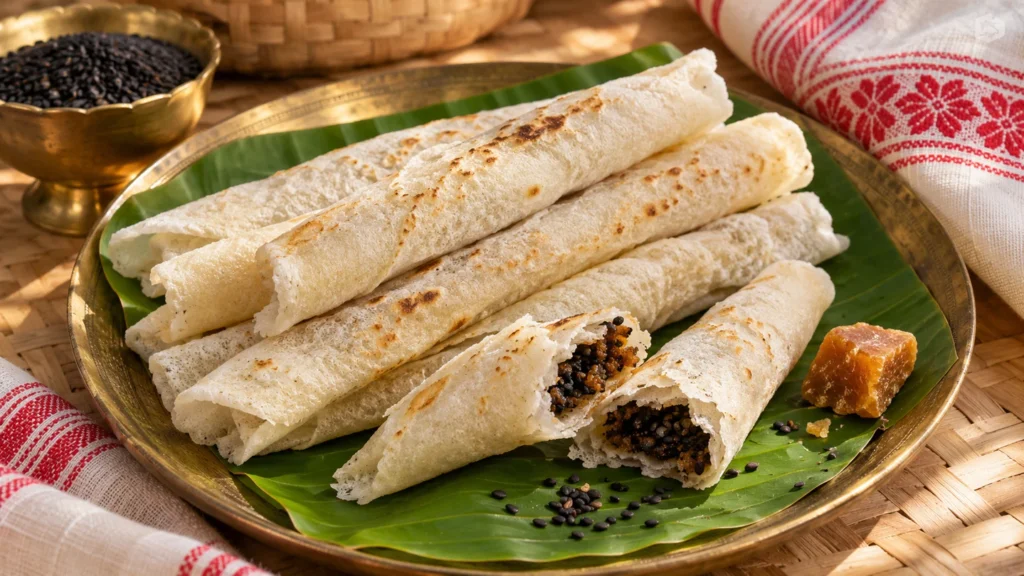
This til pitha recipe brings an Assamese winter favourite to your kitchen. A thin layer of sticky rice flour is cooked on a dry tawa and wrapped around roasted black sesame and jaggery. The first pitha is your test for heat and flour texture. Once it rolls cleanly, you can make the rest the same way.
What is til pitha?
Til pitha is a rolled Assamese rice cake. Til means sesame, and bora saul is the Assamese sticky rice traditionally used for the wrapper. Assam Tourism features til pitha among the foods eaten during Magh Bihu, also called Bhogali Bihu, Assam’s winter harvest festival. Explore traditional dishes with Assam Tourism.
Ingredients for Assamese til pitha
- 250 g bora saul (raw sticky rice)
- ½ cup black sesame seeds
- ½ cup finely grated jaggery (gur)
- Water for soaking the rice
Use a sieve, a mixer-grinder, a heavy flat tawa and a thin spatula. Outside Assam, look for whole white glutinous rice sold as sticky rice if bora saul is hard to find. Start with a test roll because different rice varieties absorb water differently.
How to make til pitha on a tawa
- Soak and drain the rice. Rinse the rice and soak it for about six hours. Drain it well in a sieve. The grains should feel damp, with no water dripping from them.
- Grind and sift. Pulse the drained rice in small batches to make a fine, slightly damp flour. Sift it, regrind any coarse bits and cover the flour so it keeps its moisture while you work.
- Make the sesame-jaggery filling. Dry-roast the black sesame on low heat, stirring until it smells nutty and starts to pop. Let it cool, crush it coarsely and mix it with the grated jaggery.
- Cook a thin rice wrapper. Warm a dry tawa on low to medium heat. Scatter about two tablespoons of the flour into a thin, even circle roughly 12 cm across. Press it gently with the back of a spoon. Let the edges firm up, usually in about a minute.
- Fill and roll. Put a narrow line of sesame-jaggery filling just off centre. Slide the spatula under the nearest edge, fold it over the filling and roll gently while the sheet is still pliable. Transfer to a plate and repeat.
Why does til pitha crack or stick?
- The wrapper breaks into dry crumbs. Rub a few drops of water into a small test portion of flour with your fingertips, then re-sift. The flour should clump lightly when pinched and crumble when rubbed.
- The wrapper cracks while rolling. Try rolling a little earlier. Reduce the heat if the edges brown before the centre firms up.
- The sheet sticks to the tawa. Give it a few more seconds to set and loosen the edge gently with a thin spatula. Use a dry tawa and spread the next round a little thinner.
- The filling spills out. Leave the ends clear and use a narrower line of filling. Finely grated gur is easier to distribute.
Serve til pitha with tea or on a Magh Bihu platter
Serve the rolls with Assam black tea so the toasted sesame and jaggery can stand out. If you are planning a Bhogali Bihu spread, read our guide to Bihu pitha and Assamese food traditions. For a savoury rice-flour dish to serve alongside the sweet rolls, try our Kholasapori pitha recipe.
Can I use regular rice flour for til pitha?
For this dry-tawa method, start with freshly ground, damp sticky rice. Dry flour made from ordinary rice behaves differently and may crumble when you try to lift it. If you are trying a different sticky rice variety, make one small roll first to check how it holds.
What’s the difference between til pitha and til ladoo?
Both sweets can use toasted sesame and jaggery. In til pitha, the sesame mixture goes inside a rolled rice wrapper. In til ladoo, called tilor laru in Assam, the sesame mixture itself is shaped into a ball.

