Komal Saul Jolpan is an Assamese breakfast made with specially processed soft rice that becomes ready to eat after soaking. Often written as kumol saul, komol saul, or komal chaul, it is commonly served with curd, milk, banana, or jaggery.
Its most intriguing feature is simple: you do not need to boil the finished rice product again before serving it. However, that does not mean you can prepare ordinary raw rice in the same way. Choosing the correct product is the first step.
This Nutritional Growth guide explains what komal saul is, how to prepare it at home, what to serve alongside it, and which common mistakes to avoid.
What is Komal Saul Jolpan?
Komal saul is a traditional soft-rice product associated with Assam. Jolpan describes a broader group of breakfast or light-meal preparations; it is not the name of just one rice variety.
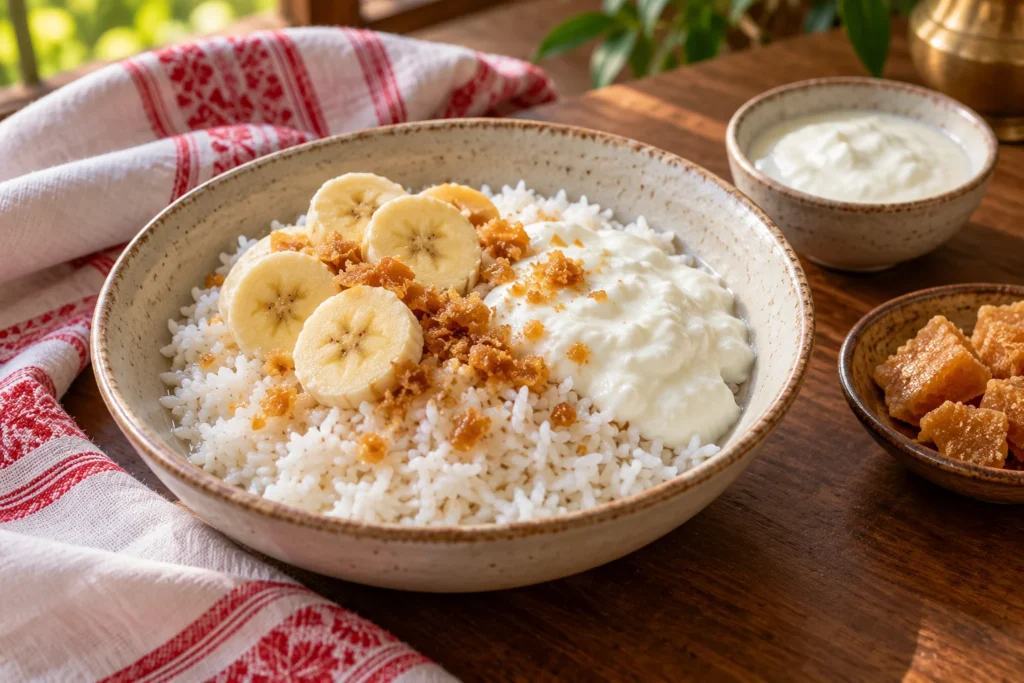
In this version, softened rice forms the base of a bowl that can be combined with fresh curd and other accompaniments. Household preferences vary, so there is no single compulsory topping.
Assam Tourism’s cuisine guide includes kumol saul among the rice foods used for jolpan and describes serving it with milk, curd, jaggery, or banana.
Why does this Assamese rice need no cooking?
The phrase “no-cook rice” describes the final preparation in your kitchen. Traditional processing already involves heat treatment before the product reaches the person preparing breakfast.
A Confederation of Indian Industry booklet on Northeast geographical indications explains how low-amylose Chokuwa rice is processed into komal chaul, which can be softened in cold to lukewarm water.
In practical terms, buy a clearly labelled soft-rice product intended for soaking. Ordinary raw rice, aromatic rice, and sticky rice should not be assumed to work in the same way.
Ingredients for a simple Komal Saul Jolpan bowl
The following is a suggested home assembly, not a laboratory-tested recipe or a fixed traditional formula. Adjust the amounts to your appetite and the instructions on your rice packet.
- ½ cup dry komal saul specifically intended for soaking
- Clean drinking water, enough to cover the rice generously
- ½ cup fresh plain curd, or enough for your preferred texture
- ½ small ripe banana, sliced, if desired
- A small amount of grated jaggery, optional and to taste
You will also need a clean bowl, a sieve, and a spoon. The quantity of the finished bowl depends on how much water the rice absorbs.
How to prepare Komal Saul Jolpan
1. Read the packet instructions
Check that you have the correct processed rice. Follow the producer’s directions for rinsing, water temperature, soaking time, and storage. Different products may soften at different rates.
2. Rinse as directed
Use clean drinking water and a clean bowl. Remove any visible debris, and follow the product’s washing instructions.
3. Soak until the grains are soft
Add the recommended water and leave the rice for the time stated by the producer. Check the texture before serving: the grains should be comfortably soft rather than hard in the centre.
There is no reliable universal soaking time for every packet. If the product remains hard after the stated time, check the instructions or ask the seller rather than assuming it is ready.
4. Drain excess water
Drain the softened rice in a clean sieve. Too much remaining water can make the curd mixture thin.
5. Assemble and serve
Transfer the rice to a serving bowl. Add fresh curd, then banana and a little jaggery if you want them. Mix gently and serve promptly. Add the curd shortly before eating for a fresher texture.
Komal saul, bora saul, and chira: what is the difference?
| Food | What to know | Preparation check |
|---|---|---|
| Komal saul | A processed soft-rice product used in jolpan | Choose one labelled for preparation by soaking |
| Bora saul | A sticky rice used in various Assamese preparations | Do not assume that ordinary bora saul is ready after soaking alone |
| Chira | Flattened rice with a flake-like shape | Prepare according to its thickness and packet directions |
All can appear in discussions of Assamese breakfast, but they are not interchangeable ingredients.
Serving ideas for your breakfast bowl
- Curd and banana: A simple combination with fruit providing sweetness.
- Curd and a little jaggery: Keep the sweetener separate so each person can add their preferred amount.
- Milk: Use an amount that gives the texture you enjoy, following the rice product’s preparation directions.
For broader meal-planning ideas, see our guide to healthy Assamese food and balanced local meals.
Common preparation mistakes
- Using ordinary raw rice: The soaking method depends on having the correct processed product.
- Following one fixed time for every brand: Use packet instructions and check the texture.
- Adding too much water to the finished bowl: Drain before mixing in curd.
- Leaving a prepared dairy bowl standing for hours: Prepare close to serving and follow suitable refrigeration and food-handling instructions.
- Treating jaggery as sugar-free: It is a sweetener, so the amount still matters.
Frequently asked questions
Can you eat komal saul without boiling?
Yes, when you use a properly processed product specifically intended to soften by soaking. Follow its preparation instructions. This does not apply to ordinary raw rice.
How long should I soak komal saul?
Follow the timing on the packet. Water temperature and processing can affect softening, so check that the grains are soft before serving.
Are komal saul and kumol saul the same name?
These are common English spellings used for Assamese soft rice. When buying, check the preparation directions as well as the name.
Is komal saul the same as poita bhat?
No. Komal saul jolpan uses a specially processed soft-rice product. Poita bhat refers to a different preparation involving previously cooked rice soaked in water.
Do I have to add jaggery?
No. Sweetness is optional. You can leave it out or adjust the amount according to your preferences.
Explore Assam one dish at a time
Komal Saul Jolpan offers a useful introduction to Assam’s distinctive rice traditions. Start with the correct ingredient, follow its preparation instructions, and keep the accompaniments simple.
Discover more regional flavours in Nutritional Growth’s guide to traditional Assamese food.